Friday, March 7, 2014

Glen Sorestad, Grave-tending

Grave-tending
                              
                                1.
Mother and Father lie side by side
in the country churchyard northeast
of the shrinking farming village of Buchanan.
After ninety-two years and two husbands,
Mother returned to the farmland of her birth
to take her earthen place beside my father,
who had moldered alone almost forty years.

                                                          2.
                            Unmarred blue overhead as we
                            move about the graveyard,
                            our feet swishing through grass
                            punctuated with wild strawberries,
                            the season more than a month past.
                            I remember summer school here,
                            fourteen, eating the tiny red delights
                            at every opportunity.  The past,
                            its taste in my mouth still lingers.
                                                        
                      
                           3.
 This rural graveyard is small as cemeteries go, tidy and well kept. 
The grass is newly mown. This pleases us.
In a land of waning congregations, closed and abandoned churches,
the homes of the dead fall to neglect, lost history.
Prairie grasses and weeds: the final grave-keepers.
It will happen here. Not for a few years perhaps,
but how long will we make this annual visit to set aright
the visitations of unruly weather?

                                                  4.
                             These huge spruce trees have long marked
                            the perimeters of this ancestral burial ground,
                            just as they have marked the bounds of a child’s memory.
                            The dark sentinels house birds, the evidence
                            spattered on every gravestone. The difficulty
                            of removal suggests bird shit runes may supersede
                            even the stone-etched grave homilies.
                            
                            We do our best to restore my parents’ joint headstone
                            to its original pristineness. Perhaps we are the only ones
                            who care one iota about how this stone appears.
                            What we do here, no matter what we may say or think
                            is, after all, really for ourselves.        

                                               
                    5.
 Artificial flowers seem tacky
as adornments for a memorial--
but they do have staying power.
We pull all last year’s blooms –
sun-faded and winter-beaten –
from the metal vase that stands
alongside the shared gravestone
of my parents. We will re-enact
this same ritual an hour later
in the cemetery fifteen miles
down the road where Sonia’s parents
and grandparents take their rest.


                                                          6.
                                I take the hand brush we have brought
                               and sweep away the grit and cobwebs
                               from the stone, the bits of leaves, fine dust
                               that has settled on and into the niches
                               of this marble monument to two lives.
                               It has been over a year since our last visit.
                               Water, wind and sun have all had their way
                               with what we set in place to honour those
                               who leave having emptied themselves of love.
                           
     
                  7.
 My maternal grandparents lie 
less than fifty feet from where
we bend to brush and wipe and tidy.
No matter where I turn, uncles,
aunts, and cousins --  all mute
as they never are in memory.
I am in the arms of family,
a quiet comfort holds me.
Some died early, some late.
Almost, I feel their permanence.

  
                                                8.
                       Just one mile north of this graveyard
                       my childhood home still stands,
                       collapsing into itself, board by brick.
                       The wilderness has wormed its way
                       into the corpse of the house
                       that weathered every storm.
                      
                       This churchyard now holds
                       a half-dozen who called that
                       two-storey frame house their home;
                       most of the others buried here
                       visited it on occasions.
                       So many stories lie here untold
                      below the prairie sod.                                                                                                
                      

                                 9.
 Sonia arranges a fresh bouquet,
positions them with a florist’s touch
into the heavy graveside vase,
vibrant, an effusive cool burst
against the muggy heat of August.
The showy new additions, artificial
though they are, announce themselves
flamboyantly to the silence of stone.

                                                  10.
                         We walk away from the cemetery
                         as we have come -- unobtrusive, 
                         contenting ourselves with doing
                         what our hearts have determined.
                         The hum of rural life is undisturbed.
                         Wind flows past, uncertain whispers.
                          Overhead the joyous sun.                            


Glen Sorestad is a well known Canadian poet whose work has been published widely throughout North America and elsewhere. His poems have appeared in over 60 anthologies and have been translated into over a half-dozen languages. His most recent books are the full-length poetry collection, a bilingual English/Spanish volume, A Thief of Impeccable Taste (Sand Crab Books, 2011) and the chapbook, Along Okema Road(Rubicon Press, 2013). 


Thursday, March 6, 2014

Susan McMaster, from Crossing Arcs

Crossing Arcs


I am lost, Mother
in the spaces you leave behind
              I cannot even see
                      a shadow there to
                                                    follow

        I have no way to comfort you in the
        empty room                           
        your mind now is            
          doors and windows    
          shut 
  
          blinds hung
          closed


I don’t think I have Alzheimer’s.
My memory is my own and I’m
going to keep it.
                                                           

Refusing the Bait

Suddenly, over a supper
of haddock and greens.
“Why won’t you let me finish
what I’m saying?” she snaps at him.
“You act like I’m stupid and old.

“And you – you never listen!”
Why are you always telling me what to do?
I can look after myself !”

I’m stuck, fork in air,
mushroom dripping sauce.

“Of course you can,” he says.
“You tell her off. Your daughter’s
always been bossy.”

The arguments they’ve had
for so many years
about science and religion,
politics and art
are done. He no longer
leaps into the fray.
Refuses any bait.
Speaks as he does
to me, when I cry.

“I don’t want to go back,”
she says to him then.

“Don’t worry,” he tells her.
“You don’t have to leave.
Stay as long as you want.
There’s no rush at all.”


I had to get angry. There’s
anger and fear, one or the
other, and I choose anger.
Anger is what keeps you alive.


Skeletoning Down

What use is a label?
This season “Type 2,”
next “OCD” or “Alzheimer’s” –
all glowers to fill a garden
of named despair.

No animal would bother.
A dog struck by sugar shock
simply lies down,
a cat with growing cancer
creeps away mute.

Words birth guilt –
blame – remorse –
when all this really is
is one way to fall

leaf among leaves
skeletoning
down.


So they finally put a fancy
name onto something that we
considered to be just getting
old. Nuts to this. My mind is
not going to play games with me.
Who does it think it is?


Hands

She takes off her boots.
Coat still buttoned,
turns from the hall
into the apartment
she left a week before.

Steps through the arch
into the living room.

Her hands come together.
Fold around each other
as if against cold.

The couch is gone.
Her lamp.
Her chair.
The floor a mess
of movers’ tracks.
A few more steps.

She stops.
Bends her head
into my shoulder.

I put my arms around her –

her hands, between us,
still closed around something
no-one can hold.
                                               
           
Acceptance and loss. Holding on
to life and what it was.


True Reckoning

This wandering, where she hits
the walls of her room –
north not where it should be,
sun gone from windows
that used to be filled.

Her square’s moved sideways
and halfway around.

How can I turn this space
to face into summer –
towards the homes she knew,
where north was straight ahead,
east was morning,
west afternoon,
and south what held
when all else dimmed?

In February shade
as I close the door behind me,
I leave her askew,
triangulated into a corner
at the back of a crooked building
that can’t be understood

skidding out of control
as the map folds up
to a darkened point.         


What does it feel like? Pods.
Skyhooks. Parachutes suspended
between sky and earth. Like I’m
in a space station detached from
everything and all the memories
are little threads trying to bring
me back.


Looking behind the Words

Crosswords and cyberquotes
consume her mornings.
Mornings too hungry without that meal.
Small leaps, small successes
are snacks and sustenance
against the hollow
that sucks the words away.

She looks up. “Hi –
What could this be –
nine letters – begins
and ends with ‘t’.
Boisterous, overbearing,
a virago, a shrew – ”

“Termagant?” I ask.
She grins. “That’s me.”


If I must live husked like a nut,
dammit you’ll hear me rattle and
shake in my shell!


From Crossing Arcs: Alzheimer’s, my mother, and me (Black Moss 2009-10). Photos by Marty Gervais. Verbatim quotes from my mother Betty Page. All material © the creators, published with permission. Crossing Arcs was shortlisted for the Archibald Lampman, Acorn-Plantos People’s Poetry, and Ottawa Book awards. Susan McMaster is author or editor of 20 books,  anthologies, and wordmusic recordings with First Draft, SugarBeat, and Geode Music & Poetry. McMaster is a former president of the League of Canadian Poets. <web.ncf.ca/smcmasterweb.ncf.ca/smcmaster>
                                                                                    

Wednesday, March 5, 2014

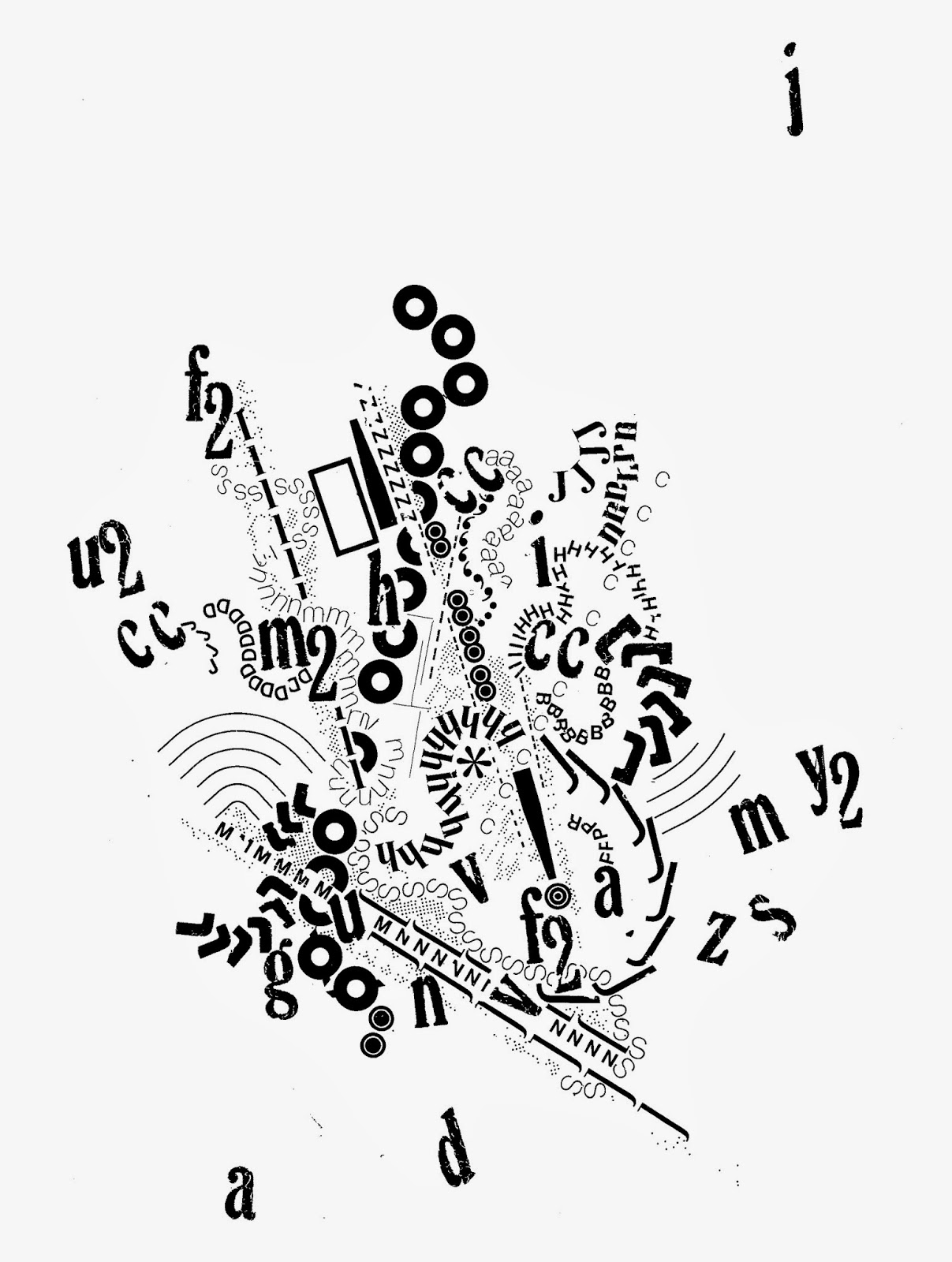
derek beaulieu, Fierce Indulgences


derek beaulieu is the author or editor of 15 books, the most recent of which are Writing Surfaces: The Selected Fiction of John Riddell (co-edited with Lori Emerson) and Please, No more poetry: the poetry of derek beaulieu (edited by Kit Dobson) both of which are published by Wilfrid Laurier University press. He is the publisher of the acclaimed no press and is the visual poetry editor at UBUWeb. He has contributed to fashion magazines such as Flaunt, Hobo and The Block, literary magazines such as The Capilano Review and Poetry and is a columnist at Lemonhound. Beaulieu has exhibited his work across Canada, the United States and Europe and currently teaches at the Alberta College of Art + Design. 

Tuesday, March 4, 2014

Pearl Pirie The Childhoods of Apostrophe and Semicolon

 Girl Holding Semicolon
Kicking Apostrophe


Pearl Pirie has chapbooks, books and ideas coming out her (www.pearlpirie.com). She has two trade collections, been shed bore (2010) and Thirsts (2011), and more forthcoming. She is a member of the Ruby Tuesdays writing group.

Monday, March 3, 2014

Rob Winger, 2 poems from Old Hat


AUTOMATIC TRIPLE-X FIREWORK JESUS


Out past the sunlit-pine median and Georgian coast,
scrubbed white sky shows us where the ocean is.

Both Carolinas are Cracker Barrel Bingo cards;
we stop at every McDonald’s for pee breaks

then leave the interstate, shuffle past real-life
bright-orange chain gangs wrestling ragweed,

patched asphalt turned to rivers by speakeasy thunderheads
outside Savannah, all the perfect alley cats nestling

into flowerpots. Over the bridge, the trees get greener;
the Spanish moss extends, Fireworks! billboards

multiply, a hundred white redeemers picketing pornshops.
South, south, past Ray Charles’ anthems into the static

alligator swamp between here and Key West,
our shelling left to a screened-in Gulf Coast balcony

then rebuilt into blue-line daydreams.
Every Smoky Mountain pass we pilot, later,

rolling all the way to Canada, is already
a Road Atlas away from Disneyworld.

In this barnacled seashell rests every road we took.
If you put it to your ear: the truck stops.


CELLPHONE


I’m explaining to my class that no one knows
anything about anything.

Truth is a tortoise photographed
in the seventies, I say, or, as one guy puts it

from the back row, the only thing for sure is that
“I do and/or do not exist,” stressing his oblique.

There’s no Walt Whitman, I’m saying, up there,
in a respectable shirt made in Bangladesh,

unless we all agree that the milk in the glass
from the cow is the farmhand.

Outside, the sky continues its meaninglessness.
The potted plants don’t bother to lament.

Heels sink into lawns and airplanes become algorithms
for the deep weight of heavy water.

There are espressos digging in
beyond the lectern’s bored cement.

Everyone, I’m saying now, eats the carrot root
and throws away the flowers.

Nothing I say is ever ready
for reason.


Rob Winger’s first book, Muybridge’s Horse, was a Globe and Mail best
book, shortlisted for the Governor General’s Award, Ottawa Book
Award and Trillium Book Award for Poetry, and won a CBC Literary
Award. His critically acclaimed second collection was The Chimney
Stone. Born and raised in small-town Ontario, Rob currently lives in
the hills northeast of Toronto, where he teaches at Trent University.
His third book, Old Hat, is due from Nightwood in March 2014.

Sunday, March 2, 2014

Late Fragments by Jannie Edwards

  Late Fragments

1.       Nostalgia

Remember Old Lang Syne,
his spastic wooden leg, his catarrh?
How we’d get him going on train whistles and mothers
after the fourth or fifth pint?

Ah, Nostalgia. Just ain’t what it used to be.

2.       Grudge

Wind rehearses its rut,
grists its ledger of damage, worries
cracks,  hinges.

Unfair! Unfair! It cries
from its dry heart, starving
in its stubborn quarrel.


3.       Blame

The armed game of shame,
the fling and flung of do and done,
blind man’s bluff of squat and strut.

Oh, pidgin soul in the wallow
of whodunit,
Undone.

4.       Feeding 

I am burning the library to cook nettle soup.
I call it staying alive.  You call it feeding the wrong wolf.

Words on the verge of becoming extinct 
hive my tongue: Pulchritude, Doxology.

Words that conjure pox
but mean Beauty, Praise.


5.       Meanwhile, Time . . .
Vladimir Nabokov, tireless lepidopterist, wrote:
“I have dissected and drawn the genitalia of 360 specimens.”

What can you, I, say of our work?


6.       Dare

Who was it who said  
Happiness writes white?

Bring on the blizzards!

Harness the sled dogs!


Jannie Edwards: If these late fragments have a literary lineage, they are begat from the aphorism, the joke, haiku, graffiti messaging and the soundbite. They aim to reach the word weary.  "Dare" was first published in  40  Below: Edmonton's Winter Anthology, ed. Jason Lee Norman, Wufniks Press, 2013. 
Photo: Cindy Gagnon.

Saturday, March 1, 2014

Steven Heighton Three Addresses


         ADDRESS BOOK


Bad luck, it's said, to enter your own name
and numbers in the new address book.
All the same, as you slowly comb
through the old one for things to pick

out and transfer, you are tempted to coin
yourself a sparkling new address,
new name, befitting the freshness of this clean-
slating, this brisk kiss

so long to the heart-renders—every friend
you buried or let drift, those Home for the Aged
maiden relations, who never raged
against the dying of anything, and in the end

just died.  An end to the casualties pressed
randomly between pages—smudged, scribbled chits
with lost names, business cards with their faded
bold-fronts of confidence, solvency.  The palimpsest

time made of each page; the hypocrite it made
of you.  Annie, whom you tried two years to love
because she was straight-hearted, lively, and in love
with you (but no strong-arming your cells and blood);

Mad Carl, who typed poet-to-poet squibs in the pseudo-
hickish, hectoring style of Pound, all sermonfire
and block caps, as AINT FIBRE ENOUGH HERE, BOYO,
BACK TO THE OLE FLAX FIELD . . . this re a score

of your nature poems.  When he finally vanished
into the far east, you didn't mind the silence.
Still, this guilt, as if it weighs in the balance,
every choice—as if each time your pen banished

a name it must be sensed somewhere, a ballpoint stab, hex-
needle to the heart, the treacherous
innocent no of Peter, every X
on the page a turncoat kiss . . .

Bad luck, it's said, to enter your own name in the new
book—as if, years on, in the next culling,
an executor will be leafing through and calling
or sending word to every name but you.


               DRUNK JUDGEMENT         


                    A night address  


The world is wasted on you.  Show us one clear time
beyond childhood (or the bottle) you spent your whole
self—hoarding no blood-bank back-up, some future aim
to fuel—or let yourself look foolish in reckless style
on barstool, backstreet or dancefloor, without a dim
image of your hamming hobbling you the whole while.
Voyeur to your own couplings, you never did come
with them, did you, even when you did?  You said Hell
is details, when Hell was just the cave, the concave-
mirrored skull you dwelt inside, your left hand
polishing while the other shook to clinch a deal—
Provide, provide!  Sure, in the end, like any soul
you were endless and yets—brave, deft with phrases, kind—
three cheers for you.  Too closed to want what others love
you vetoed life—
                                were there other worlds to crave? 


           HOME MOVIES, 8 mm


What holds you here, besides small shocks
of delight, then embarrassment, seeing these too-fast
films unravelling, mute but for the sprockets’
plastic chatter, an outboard roar as the almost-

antique projector, Yashica 1965, splashes clips
of faces in their once-loved form (forgotten
till now—interred in the nerves) on screen. What keeps
you here tensed, if not frustration

at your impotence to intervene—reach back
and brace the hand holding the camera that pans
away, again, with a young hand’s
impatience to contain all: slaphammer first home, a block

of Main Street rising between houses
to a mine’s brontosaur headframe, in the laser-
blue noon of subarctic winter—
then, in a dress-coat the colour of roses,

a mother, breaking the frame, waving a newsreel’s            
sped-up wave, while from the left a dog lollops in,
unrecalled as ever so small,
so awkward!—and you rush the screen,

kneel closer and again the camera
swivels away—
stout neighbour in dark overcoat and fedora,
mouth going—while to the left you can almost see

her and that dog in the dark, or wherever the place
is, forty years out of frame (both dead now), as the man in the coat
tips his hat and the scene cuts, to white.  Greece
then, Nipissing, faces in flashes, the light

sallowed, even children stained by that ambery
tone, as the lens pivots faster, refuses focus,
close-up, the patient frame.  I know how memory,
what these reels were meant to fortress,

aims the same fickle lens, leaving gaps and blurs
in the record, but what of the eye itself, as it glides 
over a lifetime’s loves the same way—careless
and rushed, a manic amateur—

and the little reel clicks down inside?                  

If I could start over, I would stare and stare.


Steven Heighton is a novelist, short story writer, and poet, and he also reviews fiction for the New York Times Book Review. His novel Afterlands has appeared in six countries; was a best of year choice in ten publications in Canada, the USA, and the UK; was a NYTBR editor's choice; and has been optioned for film.  His poetry collections include Patient Frame, The Address Book, and Stalin's Carnival.  His poems and stories have received four gold National Magazine Awards and have appeared in London Review of Books, Poetry, Tin House, Best American Poetry, Zoetrope: All-Story, Agni, TLR, London Magazine and Best English Stories.  www.stevenheighton.com
Photo: Mary Huggard

Truck's new drivers for March 2014

Say hello to Colin Morton and MaryLee Bragg, Truck's new drivers for March. The keys are just above the sunvisor, guy and gal.

Many thanks to John Oughton for spinning our wheels through February.