Friday, January 11, 2013


2 Poems by David Ray


IN THE NATIONAL CATHEDRAL

After John Betjeman’s “In Westminster Cathedral”

Let me in this holy place
upon my padded knees
thank you, Lord, in this case,
for Victory, when you please.
My troops upon the distant sands
have nobly pursued the Muslim bands.

But I need much more support
for my latest surge, although
I know that You, God, are with us,
just testing our faith, as you know,
but the evil terrorists still hold out.
With due respect, Lord, you
allow too many of them to be born.

I must remind you, Lord, it is
your crusade as well as mine
and our pious Christian nation’s.
So please help us, I humbly plead,
with more concern for our Occupation.

It is in your hands and interest, Lord,
to bring about swift Victory, and I do
mean sooner and not later, lest I lose
my well-deserved Legacy.  I know,
Lord, that You mean well, but to
be frank, you have led us into holy hell.


PENILE ANXIETY

“It’s time to let Napoleon’s penis rest in peace.”
                                                                        -- New York Times
Whether Ernest Hemingway told the truth
in his memoir A Movable Feast

is a matter of opinion, but he claimed that
one day after lunch with

his companion F. Scott Fitzgerald, whom
he often mocked, Scott asked

if Ernest would accompany him to
the toilet, where he took out

his penis and showed it to Ernest, asking
if it was abnormally small,

which was what Zelda had told him.
But Ernest replied that Zelda,

a castrator, was just trying to kill him.
Ernest took out his own penis so

that Scott could compare and see
that there was not a great

difference between them. But Scott
could not control his anxiety,

so Ernest told him that he looked
down at the wrong angle

and that he should go to the Louvre
and look at the naked statues,

no better endowed:  “Most people
would settle for them.”

“But I wanted you to tell me truly,”
Scott said.  So Ernest walked him

to the Louvre, but it took the Ritz Bar
to calm F. Scott Fitzgerald

and a taxi to get back home to Zelda.


David Ray is author of 23 books, including Hemingway: A Desperate Life (Whirlybird Press), When (Howling Dog Press) and After Tagore:  Poems Inspired by Tagore (Nirala Editions).  Music of Time: Selected & New Poems (Backwaters Press) offers selections from fifteen previous volumes, several of which received national awards.  The Endless Search (Soft Skull Press) is a memoir.  David co-founded Writers Against the Vietnam War with Robert Bly in 1966, and his activism continues to challenge.  An emeritus professor of the University of Missouri-Kansas City, where he also edited New Letters and founded, with Judy Ray and Robert Stewart, New Letters On The Air, David now lives in Tucson and writes poetry, fiction, and essays. He can be reached at www.djray@gainbroadband.com

Thursday, January 10, 2013


8 Photos by Alan Britt

                                              Myron says, “What’s yours is mine!”

                                                              Back to Nature!

                                                                   Sky Diving!

                                                I Ate the Leopard!

   
                                                     Red Tulip

                               Not Exactly what Twain Meant by “Roughing It”

                                           The Onondaga Sends a Strong Message

                                                 Forever Young!

Alan Britt's interview at The Library of Congress for The Poet and the Poem (www.loc.gov/poetry/poetpoem.html#alan-britt) will air on Pacifica Radio in January 2013. His interview with Minnesota Review is up at http://minnesotareview.wordpress.com/. He read poems at the World Trade Center/Tribute WTC Visitor Center in Manhattan/NYC, April 2012. His latest book is Alone with the Terrible Universe (2011). He is Poetry Editor for the We Are You Project International (weareyouproject.org).


Chelsea Britt - 4 Photographs


Polar Bear Dream


Down Looking Up

                                                         Day of the Ostrich

Cousin Keri Feeding the Giraffe


Chelsea Britt loves taking pictures of just about everything: people, animals, dreamscapes.  She manages the Massage Envy in Lutherville, MD and studies Sports Management and Marketing at Towson University. She enjoys an uncanny talent for geography and plans to travel the world to experience the beautiful diversity of other cultures.


4 Poems by Andrea Moorhead


Distances Traveled
           
Hooves along the ground and the sky liberated
the fleece wanders and we haven’t found anything else here,
trials of coal furnaces, jets of iron, the conflagration expected
in the green green and always but assaulted
at the stroke of and magic cannot dissipate this uneasiness
lean against the boundaries, incursion and infraction
but the papers are clean-clear and resolute:
no one enters without wiping first and the feet next into this cage of
respectability and shedding grace as the only impediment
and hooves along the ground lead to the sea
salt sting and careless
the rocks have left their own impressions
hard-wired to the soil sky sun.


Definitions

terrible doubts, they say, and I haven’t a clue to what that means, terrible and anfractuous, terrible and misleading, terrible and dangerously poised, that could be it, the result of too much drowning thinking recalling whether or not and terrible, they say, as if the rain bent around the lungs and the cataclysm were today not and then tomorrow clear again, blue green in the near and the distant hills always suspended entire to be dealt with whenever and then we cannot repeat this adage strange particle of desire, can we?


About the relation between

did your feet and the dictionary not withstanding
an isolation of language unpredictable and complete
your words skittering on the icy surface
it is January, you know, and the wind at the face and the ice at the eyes
and this stinging smarting along the lips prevents
comprehending words as they tumble out and subdivide
some sort of random creature, microscopic, no doubt,
and did your feet and the dictionary not withstanding
give you any clue about the relation between
and because of this tendency to avoid withstand resist
and it is snowing ever so and gently
the links are broken and we can wander all the way
without consulting the forlorn and duplicitous
transformer of what little light we see.


Bewitched

Yellow chromosomes, a spectacle you cannot tolerate
this winding twisting reformatting jungle of
and the qualities always not present
suppressed static and then again you found out something
the yellow was lighter and swifter
the red-blue invisible to your eye and hands running along
the bark of a tree could raise up yellow chromosomes
the kind physicians never remember
the kind hiding along the cortex of the mind,
the softest petals at night are blooming over by the wall
by the sunken grey stone wall
beading in the moonlight
the character of trees insolent and pure.


Andrea Moorhead was born in Buffalo, New York. Editor of Osiris and translator of contemporary Francophone poetry, Moorhead publishes in French and in English. Poetry collections include From a Grove of Aspen (University of Salzburg Press), Présence de la terre (Écrits des Forges), De loin (Éditions du Noroît) and Terres de mémoire (Éditions de l'Atlantique). Translations include The Edges of Light by Hélène Dorion (Guernica Editions), Night Watch by Abderrahmane Djelfaoui (Red Dragonfly Press), and Stone Dream by Madeleine Gagnon (Guernica Editions 2010).


The Art of Duda Penteado 

                                                              Duda’s Mural

                                                                 Image #1

    Image #2 

                                                                  Image #3

                                                                  Image #4 


                                                             Duda in Action 

Artistic Revolution
Abraham LubelskiPublisher NY Arts Magazine

“…my art pieces are not an end in and of themselves, but a means of arriving at a fundamental human truth: the struggle of the carnal and the divine in our lives.”

According to the revolutionary Brazilian educator and pedagogical theorist, Paulo Freire, the ideal aim of education is to be the “practice of freedom, the means by which men and women deal critically and creatively with reality and discover how to participate in the transformation of their world.” Continuing Freire’s legacy and heeding the call to radically transform the world through creativity and empowerment, the Brazilian artist, Duda Penteado, has dedicated over ten years to honing not only his own personal art practice, but also to sharing his passion for art with New York City metro area youth through a variety of urban arts outreach initiatives. The most recent of a long list of notable projects, is his Global HeART Warming project. Located in Bedford Stuyvesant, Brooklyn, it is a 100 x 72 foot mural commissioned by the CITYarts Foundation, aimed at raising awareness about climate change.

The finished mural, a collaboration executed between Penteado and his students, consists of a Pop-Surreal landscape reminiscent of George Garnett Dunning’s classic animation of The Beatles’ The Yellow Submarine. The joyous and compelling mural depicts a people, flower, bike, and car-filled road, flanked by brick red mountains and verdant rolling hills on one side, and Hokusai-inspired ocean waves on the other. A funky yellow factory is situated in the foreground, and a vibrant collection of city skyscrapers looms in the distance. “Nature is in love with the earth … Nature is spring blossoms … Nature’s tears are earth’s floods” is written in yellow letters hovering in a starry night sky like undulating air currents above a large yellow bird of peace.

“Philosophically, my mission as an artist is to empower and to create dialogue about difficult issues,” he says. “… In my case, my art pieces are not an end in and of themselves, but a means of arriving at a fundamental human truth: the struggle of the carnal and the divine in our lives.”

Despite the obvious historical links of this kind of large scale public painting to the Mexican Muralist movement of Diego Rivera, David Alfaro Siqueiros, and José Clemente Orozco, Duda’s personal art practice seems to follow more from a long tradition of Latin American modernist, surrealist, abstract, and figurative artists including Juan Batlle-Planas, Rufino Tomayo, Roberto Matta, Jorge de la Vega, Hilton Berredo, and Beatriz Milhazes, as well as the vibrant traditions of street art vital in both New York and many Latin American urban environments.

Take his recent Bird of Revelation wall installation at Jersey City’s City Hall exhibition entitled Deck the Hall. Penteado’s expansive mural consists of a brushy silver ground, on top of which float quasi-representational/quasi-abstract elements, including flat sky blue leafs protruding from jagged brown and orange tree limbs, which jut into the composition at off-angles from some unseen tree. Large comic-style single eyeballs in orange, each with a single vulture foot, and a pair of droopy ghost-like angelic wings, are perched on these limbs. The image is surreal in execution, drawing to mind the hallucinatory imagery of Cuban surrealist, Wilfredo Lam, yet evincing an approach that is unique to Penteado’s hybridic style and set of influences. The work is equally disturbing and comical, bringing to mind a cartoon Halloween nightmare, something akin to Pee-Wee’s Playhouse meets The Nightmare Before Christmas.

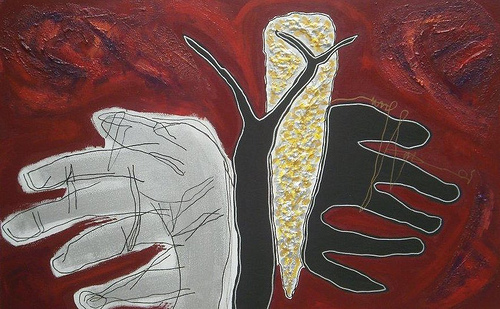
Also notable in Penteado’s vast oeuvre is his recent acrylic on canvas painting series entitled the Glocallica Series. These images represent a series of deformed hands, sometimes morphing with or juxtaposed against cragged tree branches (a recurring motif in Penteado’s work), all of which is juxtaposed against a backdrop of abstracted color fields. In one image, we see a goldenrod colored canvas, with a large black hand morphing into a tree. The image bears automatic-styled contour-line drawings, as well as a blue floating reverse-tear drop shape almost quivering as it hovers in the far right hand side of the composition. In another image, we see a textured crimson ground, superimposed with a centrally-located black tree trunk, with two hand-shaped wings flanking it to either side, and a yellow abstract form similar to the upside down tear drop from the previous image. In another canvas, reminiscent of Jean Dubuffet’s Art Brut handling of paint, and Jean-Michel Basquiat’s approach to line work, Penteado depicts two abstracted hands, one in electric blue, and one in a smudged silver, both contoured with free flowing loose line work. The background is in lax blocks of color: black, gold, and red. In these, and other works in this provocative series, the artists proposes multiple reference points and interpretations from duende-inspired visions to the horrors of war. These kooky and creepy dream-like images verge on the abstract, but evoke strong symbols from the Black Power fist of freedom to the limp outstretched fingers of zombies, Penteado’s pop culture references are subtly embedded into open-ended and animated forms of representation, resulting in what critic José Rodeiro has termed the “urgent 21st century rehumanization of art and culture, … which dare to forestall rampant technological dogmatism, bellicose neo-futurism, ravenous materialism, scientific transgenic art (bio-art) or mere reductivistic ornate decoration.”

“How can an artist working in the twenty-first century continue to create original works of art after the overwhelming presence of remarkable twentieth century art movements like Cubism, Dada, Surrealism, Bauhaus and Cobra?” Penteado queries. It is clear that he draws on his vast knowledge of art history and contemporary trends, and yet he is able to produce unique images that draw on all of these diverse cultural and historical sources while providing novel, fresh, and compelling visions that inspire us all to look at the world with new eyes. In the end, this is perhaps his most revolutionary act.      


Duda Penteado lives and works between Brazil and the United States. He has completed several projects, lectures, exhibitions and murals in universities and institutions, such as Jersey City Museum; Biennale Internazionale Dell'Arte Contemporanea, Firenze, 2009; Monique Goldstrom Gallery, NYC; MoAaA-The Museum of Art and Origins, NYC; BACI-The Brazilian American Cultural Institute, Washington DC; Museo de Las Americas, Denver. He has received awards and recognition from various institutions in the U.S., including Geraldine R. Dodge Foundation, The Robert Flaherty Film Seminar; American Graphic Design Award, Interactive Multimedia Installation, NYC. He is the co-founder of the We Are You Project International (weareyouproject.org) that is rapidly sweeping the planet.

3 Poems by Fred Wolven


PLEASE GIVE ME A DRUM,
DINNER WILL HAVE TO WAIT
 
This is a new composition becoming
something with a fresh voice,
like a portrait of a woodlot scene in language
akin to a modern, new mode
for expressing minutiae
oft times like though not Queen Anne’s Lace
peopling a meadow.

Ah, remembering,
he said it better than I,
march on, march on
for the stretch to reach the stream
is an hour or so from here,
and this poem, heavens,
I just don’t know now,
may be another day’s journey or yet perhaps
even a story recollection in front of us,
and some tales are difficult to mesh
in a finite manner.

So, ah, where is my flute?
Please give me a drum.
I’ll refresh at the stream,
dinner will have to wait.
It is now Spring,
and love, that yet new feeling,
is nearer in the air.


WEARING CHANTILLY LACE

I couldn’t help notice he was all decked out
in Chantilly lace, even more so, I suspect
than Prince Charles when he was young.
If one can so clothe in their fifth or sixth decade,
then why not strut about as the head rooster
organizing a hen house whatever the number
in the lot.  After all, the smallest field mouse
would, if it could, disguise itself to resemble
a lizard to not attract birds of prey on a
summer’s day.  And then I remember, quite
out of character, how it feels, sometimes,
when I prepare for the day, as though
I am dressing a battlefield wound, covering
what will become a scar so unlike the
remarkable multi-colored free-standing
faces of wildflowers dotting mountain-side
meadows one encounters backpacking
the trails in Georgia or even Tennessee. 


SERIAL POEMS, GROUP 4: ARTISTS

# 1

What did Chopin do
when he misplayed the fingering
what did he need
to recover his balance
when he slipped off the stool

Do you believe Mozart realized
his Concerto for Clarinet
would be the backdrop for
a award winning movie

I remember viewing Picasso’s Chicago
sculpture, called either The Picasso or
Picasso’s Chicago, located in Dailey Plaza
and noticing its imaginative form
whether patterned after an attractive woman
or Picasso’s pet dog or strictly an abstract
is of little importance
as it is a remarkable work of art

I used to wonder if Hitchcock was
so vain that he had to include himself
within each of his movies, but then
I merely figured he was only adding
a subtle element to the films
something which would be noticed
and questioned but not puzzling for viewers

The question is not
what makes an artist an artist
but what makes a creation worthy
and why does some work become classic


Fred Wolven is retired from academic life, the teaching portion, and having re-established Ann Arbor Review as an international journal, he continues the quest for fashioning just the right poem, and gaining a better understanding of the enigma that is his and that which was the late Theodore Roethke’s. After all, Roethke once said, “What I love is near at hand.” Thus, there is much yet left to be explored; plus, as he noted, “Being, not doing, is my first joy.”  What with nature’s beauty all around, and having opted to re-open himself to love and life, and still seeking to define his identity, he writes on, writes on…


4 Poems by Kristine Marie Cummings de Suarez


Empty Rooms

I’ve always loved empty rooms
but it doesn’t often happen I find myself in them.
We arrive laden with stuff
and they clutter quickly.

But every once in a while, it happens.

It was a long time ago, taking leave of Barcelona.
All our belongings packed up and taken to the port
mute boxes waiting for the boat.
At night, I sat in the darkness of those empty rooms
looking out across the city.
There was nothing left to do
but sit and notice
everything that was left behind.

The air
the stillness
the contours of the room
my breathing

And the warm fragrance of your body cavorting through the air
unencumbered
no need to find its way around sofas and tables
and books and lamps
and brooms and umbrellas and spoons.

As I said, I love empty rooms.
They are hard to find
and even harder to maintain.


Early Morning Rain in the Amazon

                                I

The early morning rain whispers blue shadows
as morpho butterflies fold their wings of dust in silence.
A shower of blue powder falls in my irises.

       II

Last night
our bodies desirous each of the other
but heavy with cares of the mind
we slept forehead to forehead
arms entwined
throughout the dense and humid night
unmoving.

The bed sheet opens its folds as we awake
exhaling the redolent mingled sweat of our bodies
and we inhale the calid fragrance
of having made love
 inside the blue shadows of our sleep.


The Heart of the Matter

a heart cannot break
too soft to find fissures
that could open a chasm of refuge

a heart can become disheveled
wild, howling in a storm which mutes its scream
shrouding its voice in fur and velvet
swelling until it has no edges
diffuse, confused with everything else
with sinew and bone and blood and hair
pulsating with beats that flood the eyes with wounded birds

If only our hearts were of harder matter,
they could break, cleanly.


These Heavy Leaves

The rain falls on these leaves
but these leaves are not mine.
Far away to the North,
hidden leaves are dormant
about to unfold.
Those leaves are mine.
But I lay down upon these thick leaves
heavy with tropical rain.

Amazonia, Bolivia, 2009


5 Poems by Nicomedes Suárez Araúz

           Nicomedes reading at Jose Rodeiro’s salon as Jose absorbs the energy of his words
                                                            (Photo by Alan Britt)

                                         Kristine and Nicomedes in Cadaques, 1991

                                      Kristine and Nicomedes acostados in the den


5 Poems to Kristine

Longing

I spring forth from your center,
orchid, Eros´ flower,
blue opening to the dawn
and its green shadows.

Watching the river
I have neither arms nor hands.
I cannot caress your womb,
your back, your body, full
of waters and distant places.

In the turbid waters
I do not sense the danger,
For my inner voice wraps around
your perfect slender form.

I arrive to your body, left breathless,
and I know I cannot miss.
I know that together
we will die on the beach,
longing for our children.


The Memory of Your Body

How that wave crests from your blue eyes
with their grey splinters of salt
and scattered seagulls.

Slowly, folding and folding again,
bell of water ringing lighter
than translucent mica from the moon.

Here a folding: your body arches;
another there and your hair of dawn
folds over the curve of your shoulders.

I dive into the center of the warm salt of your eyes
and swim toward your edges.
In your luminous smile I see the precise source
that surged from time to shape your body
a source lighter than my memory of your body.


Fragments of a Summer Dream

You recline in the valleys of your body
and the sea pulses in your heart.

A drop of water
a blue voice
your eyes.

What cities were those?
I don´t remember itineraries.

Whenever I forgot
the moon
I woke up in your night.

On your face
the shadows of dusk
were always falling on your smile.


Our Pulse

Sea.
It is full of skin.

On the beach, my love
eats green strands
of her thoughts.

Sea.
It is full of rooms
waiting only for the fall
of our legs.

Sea.
Without vertebrae
runs and wanders through the corridors.

Beneath waves of sheets
two pulses are one.


Red Earth and Rain

The quiet murmur of time after midnight.

We pass through the night
and reach the still sleeping villages of dawn.
Even the wider world
has surrendered its forms so as to sleep.

Your breath quickens
Our love almost impossible to bear.

In love our hearts are
like red earth and  rain
mingled, never to part.

Nicomedes Suárez Araúz is a poet, short story writer, essayist, aesthetic theorist, translator, visual artist, and professor of comparative literature.  In 1977 he received Bolivia’s National Prize Franz Tamayo. He is internationally known for Amnesis, his aesthetic theory of artistic creation based on amnesia as a structural metaphor. Pedro Shimose notes that Suárez ‘founded the Kingdom of Loén, a literary space that the poet rediscovers through the imaginary reading of Gonzalo Mendoza de Arroyos, an apocryphal chronicler from the 16th century. This author rescues “The Scribes of Loén” from oblivion, dedicated –in the absence of their leader—to ingenious calligraphic divertissements.’ (Shimose, 2011). After five decades away from his country, he presently lives on the outskirts of Santa Cruz, Bolivia, with his wife Kristine, his affective as well as intellectual companion for almost his entire life. They have two children, Nicomedes and Andrés, and two grandchildren, Bjørn and Theodore.