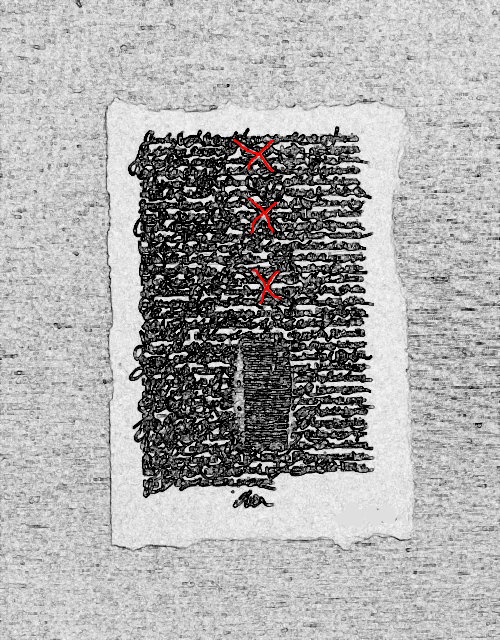
about "state of exception"
'state of exception' started out as a creative 'digestion' of my ongoing reading of
Giorgio Agamben's Homo sacer
series of books. Like all my works it is a running process, searching
for collaboration where ever possible. Personally i call it
neo-cathedralic Creative R&D, referring to my 2004 re-installment of
Kurt Schwitters'
Kathedrale des erotischen Elends, a
merzbau
that in its current form takes both the virtual but very real network
environment and the 'real' but often very fictional world as its
natural, integrated habitat (cfr. the section about the
Neue Kathedrale des erotischen Elends' ).
Agamben's
Homo sacer series starts out[1] with a meticulous analysis of the
State of Exception
(other terms: 'state of emergency', 'martial law', '(under) siege').
Within each juridical system, he explains, there exists susch a
provision whereby the sovereign power(s), in order to protect the future
of the system itself are able to temporarily or spatially limited
suspend the validity of the system itself and then proclaim the
'illegal' measures deemed necessary for the salvation of law and order.
There is (was) no civil state without a
state of exception build within it.
Originally, in old Roman law, those individuals living in such a
state of exception were reduced to 'Homo sacer', holy people in that
sense that their existence fell outside the reach of human law, their
lives were stripped of all human rights, they were no longer civilians
but 'bare life'. These individuals one could kill unpunished provided
you did not actually murder him 'as a human being' because it was to be
strictly ruled out that the
Homo sacer should infest the realm
of the dead with his 'holiness'. It is not difficult here to recognize
the process of dehumanization, that particular strategy of hatred that
is an integral part of any major genocide event in our sad history.
Agamben continues to broaden and deepen this theme[2] of a piece of
the inhuman within the human, the absolute exterior within the interior
of our experience and more disquieting, our juridical and political
systems. One can pinpoint a topology of perforation that can be
identified as
the virus of any dictatorial regime or
the excesses of 'raw' power, from the Romans over the French revolution
to Hitler, Stalin, Guantanamo,...
Furthermore, as far as Agamben is concerned, we now live in a
continuous state of exception, where at any moment in time any civil
'right' can be annulled or made void for any number of reasons of
'emergency'. Any claim to 'justice' is therefore based on a myth, not on
any 'archè' of any sort[3].
This 'State of Exception' project urgently calls for works by
creative thinkers, authors and thoughtful artists to help broaden the
awareness of our precarious condition. In times where irreversible
dramatic climate change collides with a global collapse of the political
and economical systems, where literally billions of lives are
threatened by an unprecedented global turmoil, a full awareness of our
actual condition is primordial in any attempt to actively see through
the inevitable transition ahead of us. It is up to us to contribute to
the awareness that further blind consumerism is leading us nowhere, that
as our dehumanized systems of exploitation, decentralized and nameless
as they are, reach their endgame, it does not matter who is to blame, or
what we should occupy, the only thing that matters is how to escape
those unstoppable
automata of massive destruction.
Resistance to the inevitable only worsens its consequences. Instead
we should further all our efforts to further awareness of the non-human
(transhuman, if you prefer that term) processes that control us beyond
our control, counter the forces of hatred, populism and intolerance, and
set out a path ahead for non-violent transition, reconciliation and
solidarity with the weak and the inflicted.
about the " Neue Kathedrale des erotischen Elends"
The
Neue Kathedrale des erotischen Elends (NKdeE) is
more a viral growth
than a premeditated production of any one author. There's no search for
closure, for a finished product, the search is the continuing
production of a desire towards openness, invention and the joy of
creativity, leaving all commercial pressure and the logic of
exploitation radically behind. It is only natural that all of the
creative garbage
the process produces (i.c. texts, graphics, sounds, video,...) are
released in the public domain freely, under the Creative Commons
BY-NC-SA license.
In doing so the NKdeE
redefines the author as a
function within a running Creative R&D environment. The auctorial
function is, after the required init phase, often not more (or less)
than a portal, a I/O gate of the creative process. The historical
persona with which it is linked is of lesser importance, because that
is a subjective aggregate that can, within the process environment, be
dissolved, replaced or reconfigured according to the needs of the
process that naturally supersedes its initial instantiator.
Since its creation the NKdeE has implicitly or outspokenly taking the
form of an elaborate web application (2004-2009, currently offline), a
series of blogs (2005-ongoing), the
KLEBNIKOV CARNAVAL a
yearly international festival for 'Free Lyricism' in Kessel-Lo near
Louvain, Belgium (2008-2011) co-organised with the art collective
Grapes of Art, a likewise coproduction of a weekly radio show on Radio Scorpio (Radio Klebnikov - 2009-ongoing), live performances with the
Radio Klebnikov Live Band,
the international Poetry Kessel-Lo Poezie blog, a series of graphical
researches into the practice of (Asemic) writing, an entirely web based
and radically a-commercial practice of (Dutch) writing through
http://vilt.wordpress.com and more.
dirk vekemans, november's guest editor
------------------------
[1] Giorgio Agamben, Homo Sacer. De soevereine macht en het naakte leven, Boom 2002, ISBN 9053528296
[2] Giorgio Agamben État d'Exception. Homo sacer, II, 1, Paris 2003, ISBN 202061114
[3] Giorgio Agamben, Le Règne et la Gloir. Homo sacer, II, 2, Paris 2008, ISBN 978.2020961936